
As expected, members of my parish wanted to know my opinion of the movie, “Moses the Black.” As an African American clergyman and a longtime member of the Fellowship of St. Moses, I guess my opinion would carry some sort of weight. I’m not a cinematographer or director of any sort. I’ve seen the lead actor, Omar Epps, in a couple of other movies and thought he was pretty good. I haven’t kept up with hip-hop since the very early 1990’s. So I can’t really give a plus or minus to Quevo or Wiz Kalifa. I can say that Fr. Turbo Qualls was not acting. He was being his wise, priestly self.
Some brothers and sisters expressed disappointment that more of the life and lessons of the great saint were not included. There were also a couple of details missing about the religous background. Some people probably weren’t ready for the violence or profanity (this was not a “church” movie). Orthodox Christians who saw “Man of God” may have expected more historical accuracy as the two movies were from the same director. Everybody who knows the story (or stories as the narrative varies slightly among us) of St. Moses could find something wrong with the movie. I want to start this series with what was right; redemption.
Moses was a dark skinned African (perhaps native ancient Egyptian, most likely Nubian) enslaved near Alexandria. While chattel slavery based on skin color was not present in the Greco-Roman world (the Romans had some rough things to say about their British captives), it was still an oppressive station in society. Either by escape or release by his ‘master,’ Moses was in a nearby desert where he could have died. Instead, he joined a band ot thieves. Because of his sttrength and dominating persona, he was a leader among desert bandits and developed a fearsome reputation for murder.
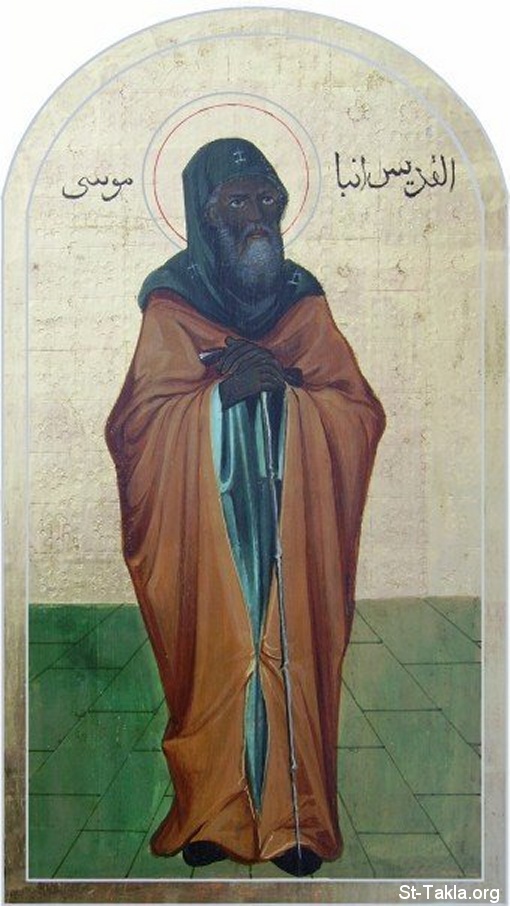
In the movie, the main character is a gang leader with a violent past. Prison didn’t correct him nor his athletic ability. He converses with his saintly gradmother who presents him with a card-stock icon of the saint. This and the shootings that he ordered and almost was a victim of, leads him to dream about Moses and reconsider his lifestyle. Too often and for a myriad of reasons, some people in violent urban areas feel trapped where they are and join gangs. The paralell with St. Moses is evidence that we all have the possibility of redemtion either in the desert or inner city.
All of us have something to be redeemed from. I grew up in a stable, two paremt, middle class family. Even the black suburban neighborhood where I spent part of my childhood was not a ‘ghetto.’ But, I had my own sorrows, struggles, and sins that could have devoured me. Truth be told, all of us had a desert, a ghetto, a gang, a habitual sin, entrapping frame of mind that we needed and still need God to redeem us from. Wheter from a luxurious villa near Constantinople or a notorious housing project in Chicago, we have the same common humanity. Without the necessary change of heart, we cannot receive salvation even in the best socio-economic conditions.

Unless we learn this lesson of redemption, can we really learn anything said of St. Moses from the Apophthegma Patrum (Sayings of the Desert Fathers), Philokalia, or more recent writings from Ignatius Brianchaninov, Nilolai Velimirovic, or some Coptic or Ethiopian source? A change or heart and life must take place first. And one last thought; we should bring our spiritual lives to a place (and frame of mind) where we can learn God’s will. Moses and many other monastics came to the desert called Sketis. The name is from an old Coptic word for place of balance.
 Desert Fathers Dispatch