
The Christian Education Department of the Antiochian Orthodox Diocese has made the Book of Exodus the focus of our Sunday School year 2025-26 and the summer’s Bible Bowl. Brainstorming ideas of teaching the Teen SOYO class, my partner advisor, Philip Riske, brought up “The Life of Moses” by St. Gregory of Nyssa as a good read. It didn’t take me many pages to wonder if many Christians habitually overlook, perhaps, the most meaningful reason to study this Old Testament text. The full title alone triggered me to this thought; “The Life of Moses or Concerning the Perfection In Virtue.”
Growing up, I always associated Moses and Exodus either as God’s law or freedom for an enslaved people. The dramatic story of the Ten Commandments is here (20:1-17 and Deuteronomy 5:1-21) as well as a plethora of other laws for God’s chosen Israelites. I remember learning the commandments from my earliest Vacation Bible School days. It wasn’t hard for any African American to see himself in the Jewish slavery to freedom narrative. The thought of our nation as a promised land for the colonist, settlers, and immigrants was a basis for Manifest Destiny as the U.S. conquered Natives from coast to coast.
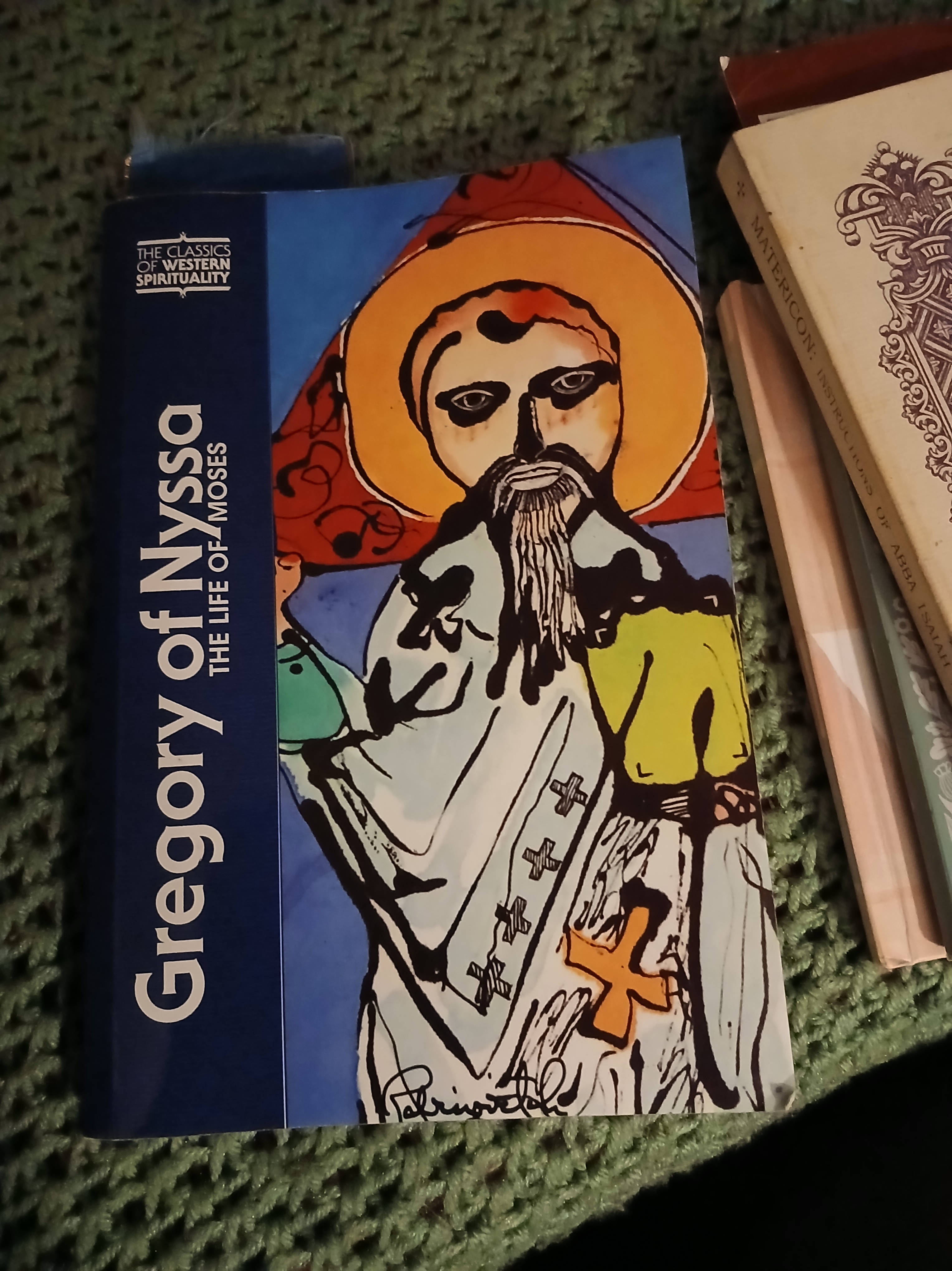
St. Gregory was fourth century Cappadocian (in modern Turkey) educated in the early Christian faith alongside his brother, St. Basil the Great, and friend, St. Gregory the Theologian. Expounding on Mosaic legalism was not a part of his life. The black Africans (Ethiopians=’burnt faced’ people) of his time were counted neither an inferior nor superior people. Even though Christianity was legal in his lifetime, Rome was not conquering other nations with missionaries in tow. Gregory approached the ancient text from a different point of view.
A believer wrote to the Bishop of Nyssa seeking instruction on how to live a perfect life. Gregory’s reply was this two-part treatise analyzing the life of Moses. He briefly details the life of the Hebrew lawgiver. But the meat of the reply was to look at the history and glean it for lessons of gaining virtues. Obeying a moral code of a particular ethnic group was not the goal of the Christian. Christ Himself made that point in healing people on the Sabbath. The faith was beyond ethnicity and law. The pursuit of holy living was for all. Gregory used the Moses narrative as an example of how to do it.
The secondary title is the mind frame we should have as Christians: Concerning the Perfection In Virtue. Ethnicity only limits whom we embrace in the family of faith. Legalism turns us into judges who can be easily swayed by our own fickle standards. Seeking perfection in virtue is the very invitation Christ calls us to in Matthew 5:48. The Father in heaven has a love that goes beyond limited barriers and earthly standards. He is limitless in goodness. All of us are called to live as such. Here, Jesus is not speaking to a few select disciples or a circle of 12 or a wider 70 apostles. He is preaching to the multitude (Matt. 5:1). When we forget, dismiss, or ignore the pursuit of virtue for laity as well as clergy and monastics, we revert back to the ethnicity and legalism as boundaries that separate and scatter us.
I leave you with a quote from the author and saint, “We should show great diligence not to fall away from the perfection which is attainable but to acquire as much as possible.”*
*Gregory of Nyssa, Life of Moses: The Classics of Western Spirituality, Paulist Press, New York & Mahwah 1978, pg. 31
 Desert Fathers Dispatch